This Vietnam magazine article (Dec. 2020 issue) is an adaptation from my forthcoming book Hot Mics and TV Lights: The True Story of the American Forces Vietnam Network with co-author Marc Yablonka
 |
Mike Turpin on the news set in Saigon. AFVNVETS.NET
|
Nothing seemed unusual about Army Spc. 4 Mike Turpin. He was
a respected TV newscaster during his time at AFVN in 1967-68. “When he went on
the air as the new anchor, he had a new uniform and looked spic and span,”
according to Army Spc. 5 John Mikesch, who was the technical director for
Turpin’s newscasts. “He had a mature, experienced presentation. He was
perfect.”
To most people who knew him, Turpin hardly seemed like a
person who would die under mysterious circumstances, yet that is what happened
in 1972 after he left the military and strangely returned to Vietnam. Nearly
50 years later, the mystery remains unsolved.
 |
Turpin in the field (right, foreground) with 1st Infantry Div. Courtesy Matt Turpin
|
Off-camera, Turpin, who spoke at least five languages, led a
life that was a perilous concoction of one part adventure and one part danger. Prior
to arriving at AFVN, he served with the 1st Infantry Division in Vietnam,
earning a Purple Heart, Silver Star and Bronze Star.
Turpin joined the Merchant Marine at age 16 in 1944 but
changed course the next year and enlisted in the Army in April 1945. He served
in Korea,
where he suffered a head laceration and earned a Bronze Star. He was discharged
from the Army in 1968.
Turpin, who went by “Mike” but whose given name was Ira
Leslie Turpin, was born Jan. 29, 1928, in Gary,
Indiana. He had five marriages,
and four of them broke up. He had five biological children and one
stepdaughter.
When Turpin died, officially in April 1972 at age 44, he was
in Vietnam
as a civilian. It’s not clear what he was doing there. Even more puzzling is
his death. There are multiple theories of what happened.
Trouble at
International House
 |
| International House in 1966. John F. Cordova Courtesy Manh Hai |
After he left the military in 1968, Turpin ran a small
bookstore at the International House, a popular downtown
Saigon
social club for foreign civilians on
Nguyen
Hue Street. That same year he married Kyong Ui,
the International House’s chief accountant, whom he had met while still in the
service. A Korean native, she was known as Kim to everyone but Turpin, who
called her Lily. She had a young daughter, also born in
Korea. The
wedding reception took place in the club’s banquet room. Lily had become
Turpin’s fifth wife.
Customers at the International House tended to be “high
military people, high-ranking Vietnamese people, Indian people, Arab people. French
people,” said Doris Hochberger, Lily’s daughter, who used to go there with her mother, who
died in 1988.
The International House had several thousand members,
according to a wartime column by Daniel Cameron in the Saigon Post. “You paid a $20 membership fee and then ate low-priced
steaks, drank the PX booze, played the slot machines and had companionship,” Cameron
wrote. “American civilians went there in droves,” he said.
Some U.S.
officials served on the International House board and the U.S. Embassy could audit
the place, but otherwise it had limited oversight. According to Cameron, a
federal grand jury indicted two managers for defrauding the American government
of hundreds of thousands of dollars. It reportedly closed in 1969.
“Everybody got subpoenaed at International House,” Doris said. “Everyone had to testify and they were
leaving town.” One of her father’s friends was subpoenaed and then killed when
his helicopter blew up. Lily’s boss, also summoned, was shot while walking to
work, but survived. Turpin suddenly moved Doris and Lily to Bangkok. “It seemed my dad was shipping us
off to get us out,” Doris recalled.
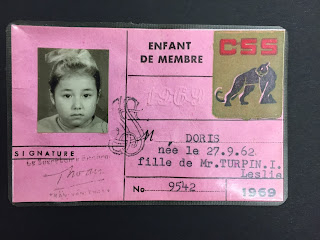 |
At age 6, Doris learned to swim at the exclusive Cercle Sportif Club
|
She was too young to understand events at the time. “When I
got older I always figured it had to do with money,”
Doris
said. “Greed. So much money went through International House. I thought it was
embezzlement, money laundering, I don’t know.”
Jocelyn Turpin, the daughter of Turpin with his third wife,
Joyce, was researching the family’s complicated history when she came across
connections between the International House and a scam involving diamonds
imported through the Post Exchange.
Clark Mollenhoff, a Pulitzer Prize-winning journalist for
the Des Moines Register in Iowa, wrote about the
investigation in 1971, reporting that a global diamond trader was doing more
than $1 million a month in diamond business through the PX system. Mollenhoff explained
that expensive jewelry was allegedly being sold through International House to
avoid high South Vietnamese customs duties. “That central fact,” he wrote, “is
at the heart of what will be one of the major scandals coming out of the Vietnam
War.”
Family members believe Turpin and Lily were both subpoenaed
to testify before a federal grand jury and a U.S. Senate subcommittee
investigating Vietnam
scandals. “He told us he was due in court in LA later that spring (1971), but
he didn’t want to go and was afraid he wasn’t going to return,” Jocelyn said.
Family members aren’t certain whether Turpin and Lily were subpoenaed to
testify s suspects, informants or straightforward witnesses.
There was no official allegation linking the couple to
illicit activities at the International House, but Turpin’s affluence did not
go unnoticed.
“My mother had a lot of diamonds,” Doris
recalled. “I mean a lot of diamonds. She had one-carat diamond earrings.” The
family moved into a large residence outside Saigon
about the time Mike left the military. They had a pool, two housekeepers and a
gardener. They hosted large weekend social gatherings, and up to 150 guests attended
some of the barbecues, including Turpin’s friends from AFVN.
Turpin also had a virtual arsenal in his house. “In my
parent’s room, under their armoires, he had AK-47 and M16 rifles, grenades, all
kinds of stuff,”
Doris said. Turpin also kept
two handguns at home, one in his night stand and one under the bed. He taught
Doris and Lily how to shoot. “One time they used a grenade launcher on a
watermelon,”
Doris recalled. “It was awesome!”
Doris provided the photo, at left, of her mom on the firing range with an M16 rifle in 1968.
Jocelyn believes Turpin might have been profiting from the black
market. “Clearly he was involved with something,” she said. “I think a lot of
people wanted him dead for the information he had.”
Killed in Combat
Theory
After the family moved to the United States in 1969, Turpin
bought a house for his parents in Florida, a car for his family and a brand new
sports car convertible for another relative—all in cash. “Dad never wrote a
check and did not have a credit card,” Doris
said. Turpin took Doris on a nationwide
driving vacation that covered 32 states in four months.
 |
Mikesch with radio starlet Chris Noel. AFVN photo.
|
At one point, the family stayed at AFVN veteran John Mikesch’s
house in
Seattle
while Turpin tried unsuccessfully to find work in television. The family moved
on as Turpin continued his job search, which landed him in a familiar place.
“He’d gone back to Vietnam to do some work for the
military or the government,” according to information Mikesch got later from
Lily and confirmed with his own contacts. “He was freelancing,” Mikesch said. “There
were a lot of new weapons being developed at that time, and he got connected
with people who were able to maintain these things, able to get hold of them.”
Mikesch believes that Turpin was killed in combat: “In one
of those skirmishes that he was involved in they were overrun. Something went
wrong . . . so that was the mystery of how it all ended.”
When Jocelyn attended a reunion and talked with Turpin’s
buddies from the 1st Infantry Division, she heard more speculation
that her dad was “military intelligence.”
Died of Nature Causes
Theory
In a letter to the family, U.S. Embassy Consul General Malcolm
Hallam wrote that Turpin’s landlord found the former soldier dead in his room
in late April 1972. “He was sitting in a chair dressed in pajamas with his head
and upper torso slumped over . . . and his head resting on a small table,” the
letter said. “There was no visible evidence of violence within the room.”
Congealed blood from Turpin’s nose and mouth covered the top of the table. Vietnamese
police “found no evidence of foul play,” Hallam stated.
 |
Mike and Lily at their International House wedding reception.
|
The Consul General said Mike’s friend, Larry Worth, president
of Worth Co. Ltd. in
Saigon, told the Embassy
that Turpin was unemployed and visited him the night before his body was found.
Worth’s business card was found in one of Turpin’s pockets. The official death
certificate, signed by an army captain at 3rd Field Hospital, lists the cause
of death as “natural” and shows that no autopsy was performed.
The body was flown to Georgia where Lily and Turpin’s
father, Leslie, met the plane to make the identification. Doris,
9 years old, did not go to the airport, but she remembers the adults talking
afterward. They were uncertain if the body really was Turpin’s.
“Mom said it could have been anyone,” Doris
recalls. “There was no embalming.” However, a U.S. Foreign Service report on
Turpin’s death says the remains were “embalmed and shipped by air to U.S.” The body
was buried at Pennville, Georgia, on May 9, 1972—11 days after being
discovered in the room in Vietnam.
Bar Brawl Theory
Another theory comes from former Army Spc. 5 Dick Ellis, who
worked with Turpin at AFVN and ran his teleprompter for the 6 p.m. news. After
Turpin left the military and returned to the United
States, he “then came back to Saigon
as a civilian and was shot in a bar incident, I understand,” Ellis said.
 |
| Jocelyn Turpin holds her dad's photo. |
The three Turpin children I interviewed were not familiar
with the bar murder story; however, they were not surprised. Jocelyn told me
that military police once went to the home of Turpin’s parents in
Georgia and
told them their son “had been found in an alley badly beaten.” When Turpin was
a younger man he would regularly get into bar fights, she added.
Standing over 6 feet tall, Turpin was an imposing man and
gritty. Before his time at AFVN, he was a reporter and anchorman at TV station WTOP
(now WUSA) in Washington, D.C. His son Matt, Jocelyn’s brother, has a
newspaper clipping of an incident that shows the reporter on the other end of a
news story. “There was some news conference in D.C., and he got into a brawl
with another reporter, and it made the news,” Matt said.
CIA Theory
One of the most tantalizing clues about Turpin’s death came
from a man who visited Lily in Florida
and identified himself as “Mr. Olson.” He told Lily he was with the CIA,
recalled Doris, who had been sent to her room but heard everything. “He was
talking about the time in Vietnam,
about International House and started talking about dad,” Doris
said. “He told my mother he was murdered and shot in the head.”
From her room, Doris could see photographs Olson had brought,
including an 8-by-10-inch black-and-white print that showed a man leaning over
with his head on a desk, an image similar to the scene described in the U.S.
consul general’s letter. The man’s face was not visible. “It looked like it was
staged,” Doris said. “It was too neat, no
mess, no blood.”
Jocelyn didn’t see the photo but also thinks the death scene
was staged, based on the embassy’s description of the hotel room. No
identifying features were given, and the lack of an autopsy prevents other confirmation,
she said.
Jocelyn has conducted a tenacious search for official
records, photographs, credentials and internet corroboration. Rather than answering
questions, however, that documentation often raises new ones.
For example, personal possessions that the embassy recovered
from Turpin’s room and returned to the family include clothing, his passport,
and items like his wrist watch and toothbrush. “I think what is unusual is what
is missing,” Jocelyn said. “Where are his pipes and books? He never went
without those.”
 |
Why did Mike have this photo in Saigon? He's at the head of the table.
|
Also puzzling are two photos the embassy returned to
Turpin’s family. They show Turpin inside Andy Wong’s Chinese Sky Room nightclub
in San Francisco—28
years earlier. One is a group photo of Turpin with about 10 men and women
around a dinner table. The other snapshot shows Mike sitting with an
unidentified woman holding a cocktail.
 |
| And what about this mystery woman? |
Jocelyn asked: “Why was this gathering in a Chinatown
nightclub so important to him . . . that he chose to bring these pictures halfway
across the world [to
Vietnam],
when he brought so few other things with him? Was it some kind of last
message?” No photos of Turpin’s own family were in the packet of his personal
belongings.
“He used to tell everybody he was in importing and
exporting,” Doris said, but adds, “I think dad
had something to do with the CIA because he always seemed to know everything
before it happened.”
Doris and Jocelyn are not blaming the CIA but believe any
work Turpin might have done for the agency could have contributed to his death.
Mike Did Not Die Theory
This theory also places Turpin in a life-threatening situation, but instead of being killed he disappears to save his life or escape other problems.
About 20 years ago, this cryptic posting appeared on a now-obsolete
AFVN discussion group: “Joe Ciokon was the daily War News Editor and the 6 PM
TV news anchor for the American Forces Vietnam Network . . . he relieved an
Army sergeant named Mike Turpin . . . strictly a “soldier of fortune” who only came
out for wars and conflicts [and] had a penthouse apartment at the International
Hotel (he was probably a spook) and R&R’d in Tokyo a lot.”
Although there is nothing definitive establishing Mike as a
mercenary or a spy, his extravagant lifestyle caught the eye of AFVN
colleagues—and perhaps others who wanted something from him.
Turpin had good reasons to vanish, Jocelyn said. “A lot of
people were looking for him, everything from ex-wives to family friction.” In
this theory, she continued, “he picked the perfect place knowing they had no autopsy
facilities for civilians in Saigon. It would
have taken nothing to pay off the landlord at that hotel, find a body . . . in
the middle of the [communists’ spring 1972] Easter Offensive . . . and just say
it was him. He wanted to disappear. He would have known how to do that.”
Doris is conflicted: “Half
of me says yes, if he passed away, there was foul play. The other half of me
says I don’t even know if he passed away at that point. So I don’t know.”
AFVN Memories
Some of Turpin’s best days in Vietnam were at AFVN as a valued
television anchorman. Doris and her mother would sit in front of the TV in
their sixth-floor apartment downtown and watch Turpin read AFVN’s evening news.
On one occasion Doris, about 6 years old, tagged
along to observe a newscast from the control room. “I remember all the guys
being really, really nice,” she said. Doris even
joined her stepfather for a story that required a helicopter flight.
 |
Mike's picture of bombing scene.
|
On May 3, 1968, Turpin was reading the 1 p.m. newscast when
a terrorist bomb exploded in the compound that AFVN shared with Vietnamese TV.
Army Spc. 5 Bob Casey, who was running the control board, described the attack
at afrtsarchive.blogspot.com: “We were about a minute in when the bomb went
off. I never shut the mic off and on the tape, you can hear the explosion, the
falling ceilings, fluorescent lights falling and glass breaking.” There were
numerous casualties but only a couple of minor injuries at AFVN. The audio recording
is on YouTube, titled “The story of AFVN radio and TV.”
Turpin was also a dedicated writer, even taking a portable
typewriter into the field. “He also contributed to a story for Alfred Hitchcock
[who hosted a television show that focused on mysteries],” Doris
said. “I remember watching it on AFVN with dad and the credits came up and
there was his name.”
As terrorist bombings became more frequent downtown, Lily
was growing more frightened. The family moved to the spacious home outside Saigon. It was not only ideal for large gatherings and
formal dinners but also a welcome place for privacy.
 |
Mike, second from left, at the Turpin residence outside Saigon.
|
As
Doris recalled, “Dad used
to come home every night from work. He would make himself an Old Forester
bourbon on the rocks, sit on the porch and start reading. He read three or four
books at a time.”
Her stepfather’s favorite song was “Those Were the Days,” recorded
by Mary Hopkin in 1968. “Dad would hold a glass of Old Forester and sing,” she
said. “I remember him playing “Those Were the Days” and singing at the top of
his voice. He used to just wail it.” Doris said her stepdad had a
great sense of humor and was always patient. “I never heard the man raise his
voice.”
But there were skeletons in Turpin’s closet, Jocelyn discovered. During the first of his Army enlistments, Turpin lied about his age—he was just 17—and signed up using a fictitious name. For some reason, he walked away from boot camp. He was court-martialed for desertion, sentenced to two years and released with a dishonorable discharge.
"The grief and shame from this situation almost killed his mom and dad," Jocelyn believes. She adds that her father "spent the rest of his life trying to make up for that big mistake."
 |
Turpin on patrol in 1966 along the Song Be River northeast of Saigon.
|
Turpin talked the Army into giving him a second chance, she said. When he went AWOL he was young, homesick and had fled boot camp, not the battlefield. He re-enlisted again, and again, and left the service with a chest full of medals for valor.
"For those that loved and respected my dad, but were confused by some of his choices," Jocelyn said, that dark episode in his life "explains so much. Without knowing this, any real understanding of who he truly was is incomplete."
Turpin's behavior might even be a model for redemption, she believes. "If it helps even one more person to understand and forgive him, or maybe inspires them to get over a rough patch in their own life and overcome their past mistakes, I feel good about it."
Like families of troops missing in action and still waiting for news of their loved ones, Turpin’s children crave closure. “I have lived with this forever,” Doris said. “When I was younger it used to creep me out. When I got older I started to understand things better.”
 |
Mike Turpin: Father, soldier and journalist.
|
Weighing the various theories of his father’s death, Matt said: “Whether it’s the bar fight or he died of some quasi natural causes or it’s something nefarious, it’s possible. I’m less inclined to think about a government cover-up.”
Jocelyn quotes her mother: “Mom said she thought he was doing something for the government and doing something important, and somebody killed him.”
There is common family agreement on this much: Turpin was a decent man, a courageous soldier and a talented journalist. Doris raves, “I absolutely adored the man, tall and lean, baby blue eyes. He taught me to be myself and to like myself. He was amazing.”
Rick Fredericksen served as a Marine newsman at American Forces Vietnam Network 1969-70.


